 Fly Tying Inventory
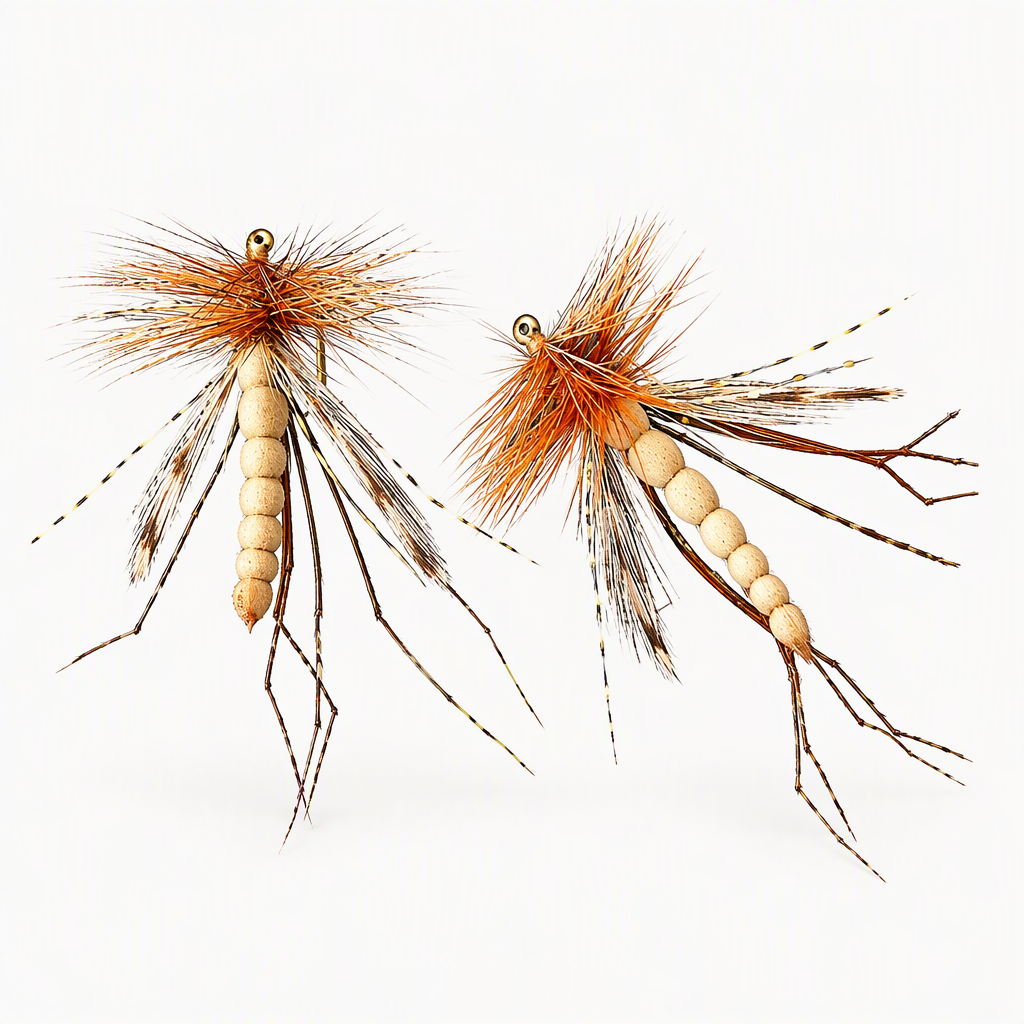
Daddy Long Legs
Crane flies, known in the UK and Ireland as daddy long legs, are blown onto lakes and rivers in large numbers from late summer into autumn, and trout take the struggling insects eagerly. Davie McPhail's version has a detached, segmented foam abdomen that floats well and holds the long, slim shape of the natural, with knotted pheasant tail legs trailing behind, hackle-point wings and a brown cock hackle. Fish it static on a floating line in a good breeze, with an occasional twitch to make the legs kick.
Ready to tie this?
This pattern needs 10 materials. Sign up free to check which ones you already own.
Materials
Kamasan B160 hook, size 8
8
Pheasant tail fibres, natural, knotted once or twice to form joints
Natural
Cock hackle points, light cree or badger (pale with a darker centre)
Light Cree
Rabbit fur dubbing, natural (any similar fur works)
Natural
Cock hackle, natural brown
Brown
A fine needle or straight pin held in the vise, to form the detached body on
Head cement
How to Tie the Daddy Long Legs
- 1
Step 1
Fix a fine needle in the vise. Cut a narrow strip, about 3 mm wide, from the tan foam and trim one end to a taper.
- 2
Step 2
Start the tan thread near the tip of the needle and tie the tapered end of the foam over it, so the rear of the body is closed and rounded.
- 3
Step 3
Work the foam forward along the needle, binding it down with two or three firm thread turns every few millimetres so it swells into round segments between the wraps. Make seven or eight segments, a little longer than the hook shank, then whip finish behind the last one.
Keep the same tension and spacing on every segment; even segments are what make this body look right.
- 4
Step 4
Slide the finished body off the needle and trim the leftover foam to a short, flat tab for tying in.
- 5
Step 5
Put the hook in the vise and start the thread at mid-shank. Tie in six to eight knotted pheasant tail legs around the middle of the shank so they splay out on both sides and trail backwards, then trim the butts.
Pre-knotted pheasant tail legs save a lot of time, or knot a batch ahead with a single overhand knot in each fibre.
- 6
Step 6
Lay the foam tab on top of the shank over the leg tie-in point, with the segmented body extending back past the bend, and bind it down firmly. Trim any excess foam.
- 7
Step 7
Tie in a few strands of pearl Krystal Flash on each side, then a cree hackle point on each side, both angled back and out over the body in a V.
- 8
Step 8
Tie in a brown cock hackle by its stalk, then dub a small thorax of natural rabbit fur over the wing and hackle tie-in.
- 9
Step 9
Wind the hackle forward over the thorax in three or four open turns, tie it off, whip finish behind the eye and add a drop of head cement.
Watch Tying Tutorial
https://www.youtube.com/watch?v=nOPcHrIDz3E
Credit: Davie McPhail