 Fly Tying Inventory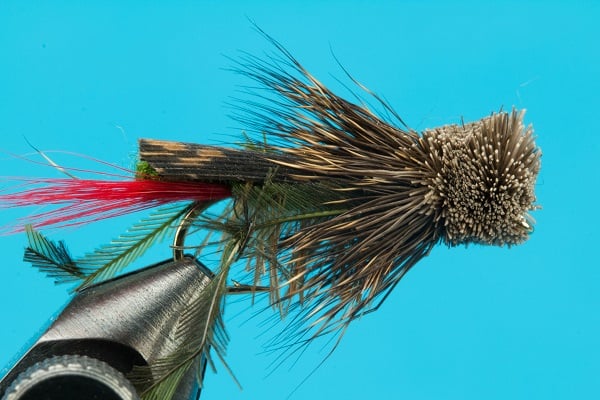
Dave's Hopper
One of the all-time classic hopper patterns created by Dave Whitlock. Features a spun deer hair head and collar, mottled turkey wing, and knotted pheasant tail legs. Highly realistic and extremely effective from late July through September. The deer hair construction provides excellent floatation while the turkey wing and knotted legs give a lifelike silhouette that fools even educated trout.
🪶 Ready to tie this?
This pattern needs 10 materials. Sign up free to check which ones you already own.
Materials
TMC 5262 or 5263, 2XL dry fly hook, sizes 4-12
Yellow or tan 6/0 (UNI or Danville)
Red deer belly hair or red bucktail
Yellow poly yarn or yellow dubbing
Brown rooster neck hackle, palmered over body
Yellow calf tail or dyed deer hair
Mottled turkey quill section, lacquered for durability
Knotted ringneck pheasant tail fibers
Natural deer body hair, spun and clipped to shape
How to Tie the Dave's Hopper
- 1
Step 1
Start thread about one-third back from the eye and wrap a smooth base to the bend of the hook.
- 2
Step 2
Stack and tie in a small bunch of red deer belly hair at the bend, about one-third the hook shank in length for the tail.
Leave the butt ends attached for added underbody bulk and floatation.
- 3
Step 3
Pull butt ends forward, advance thread, and tie down at the three-quarter mark on the shank. Trim excess.
- 4
Step 4
Tie in yellow poly yarn at the bend and wrap forward to form the body. Create a small loop at the bend to suggest a grasshopper egg sac.
Split the yarn for smaller hook sizes to maintain proper proportions.
- 5
Step 5
Tie in brown hackle at the bend and palmer forward over the body. Tie off and trim the hackle fibers short.
- 6
Step 6
Measure and cut a section of mottled turkey quill to shank length. Lacquer or coat with vinyl cement for durability. Tie in at the three-quarter point.
Treat the turkey quill with Flexament or thin vinyl cement to prevent splitting during casting.
- 7
Step 7
Tie in knotted pheasant tail fiber legs on each side, positioning the knots to suggest natural leg joints.
- 8
Step 8
Spin and stack natural deer body hair to form the collar and head. Distribute fibers evenly around the shank.
- 9
Step 9
Trim the deer hair to create the blocky hopper head shape, leaving a collar of untrimmed fibers. Whip finish and apply head cement.
Watch Tying Tutorial
https://www.youtube.com/watch?v=JDKn_Sj-zKM
Credit: Dave Whitlock