 Fly Tying Inventory
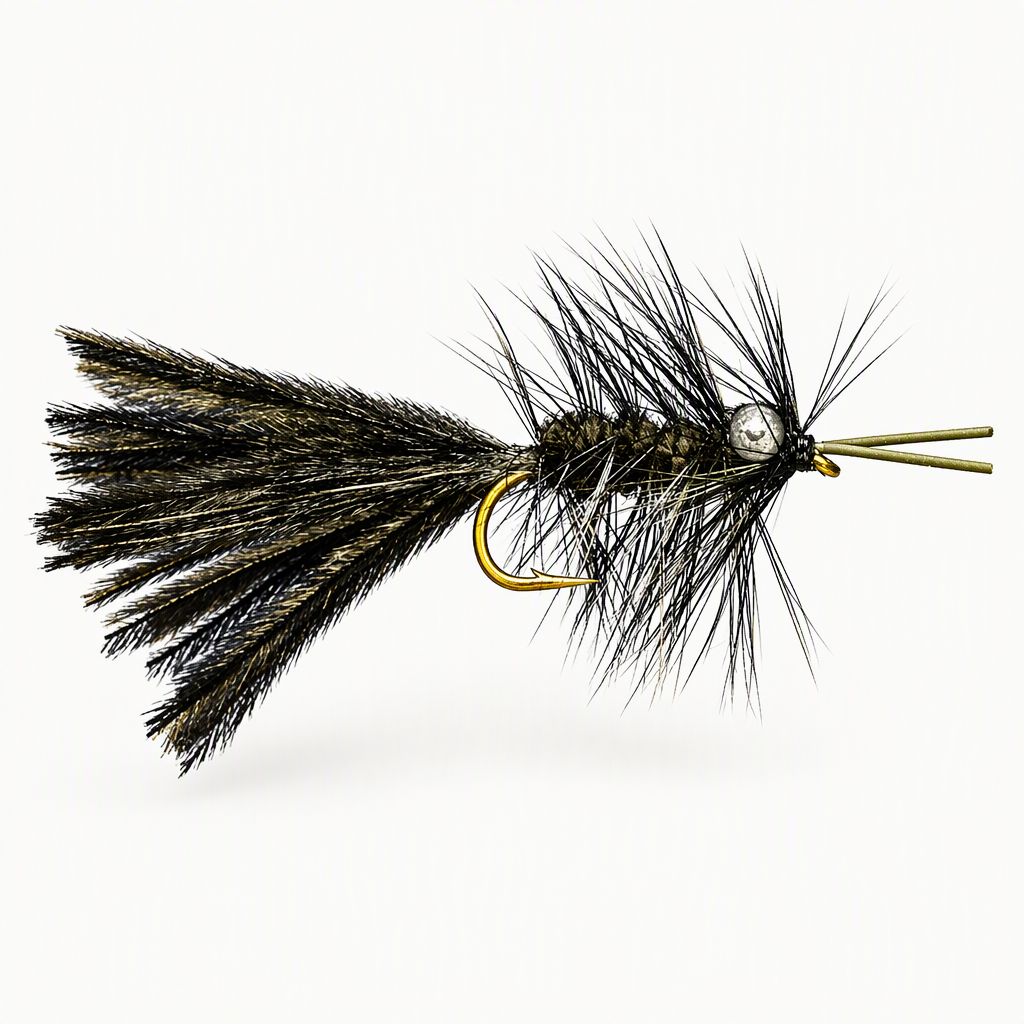
Murray's Hellgrammite
Harry Murray, the Virginia fly shop owner and smallmouth author, developed this hellgrammite after much experimenting; switching the tail from marabou to ostrich herl gave it the swimming action he wanted. It is tied much like a Woolly Bugger, with palmered hackle over chenille, plus rubber-leg pincers at the front. Dumbbell eyes give it a jigging motion, and lead wraps on the shank give a subtler sink. Bounce, swing or dead-drift it along the bottom of smallmouth rivers all season, and especially in the fall.
Ready to tie this?
This pattern needs 8 materials. Sign up free to check which ones you already own.
Materials
Mustad 9672 streamer hook (the video uses the Mustad R74 version), size 6
6
Round rubber legs, medium, black (pincers)
Black · Medium
Wapsi unpainted lead dumbbell eyes, small to extra small (or lead wraps on the shank)
Unpainted · Small
Ostrich herl, black, 15 to 20 strands
Black
Rayon chenille, medium, black
Black · Medium
Head cement
How to Tie the Murray's Hellgrammite
- 1
Step 1
Debarb the hook and fix it in the vise. Start the thread behind the eye, wrap back about one eye length and return to the eye.
- 2
Step 2
Tie a medium rubber leg strand at its middle along the near, upper side of the shank behind the eye, then fold the rear half over to the far side so the two ends splay forward as pincers at about 35 to 40 degrees.
Tying the pincers in first is much easier than adding them at the end. Leave them a little wide; the head wraps pull them together.
- 3
Step 3
Just behind the pincers, lash small unpainted dumbbell eyes on top of the shank with crisscross wraps, then take a few turns around their base between the eyes and the shank to snug them down.
For a subtler, non-jigging fly, skip the eyes and wrap lead or lead-free wire along the shank, as the original was tied.
- 4
Step 4
Carry the thread to the bend. Cut a clump of 15 to 20 black ostrich herls from the stem, tie them in from just behind the dumbbell eyes to the bend so the butts form an underbody, and trim the tail to about two shank lengths.
- 5
Step 5
Tie in a black saddle hackle by its tip at the bend, with the shorter fibres at the rear as on a Woolly Bugger.
- 6
Step 6
Tie in the medium black rayon chenille at the bend, then bring the thread forward to the gap between the dumbbell eyes and the hook eye. Run a little head cement along the shank and around the eyes for durability.
- 7
Step 7
Twist the chenille between your fingers to round it out, then wrap it forward to the front of the fly, crossing around the dumbbell eyes, and tie it off.
- 8
Step 8
Palmer the hackle forward with about four open turns over the body, one extra behind the eyes and two or three in front of them. Tie it off and trim the tip.
Keep it sparse; the hackle only needs to suggest legs.
- 9
Step 9
Moisten your fingers and stroke the hackle fibres back, then build a small head without crowding the eye, which would squeeze the pincers together. Whip finish.
- 10
Step 10
Trim the pincers so about half a shank length sticks out past the eye, and coat the head with cement.
Black is the classic colour; brown and olive also work. Change the thread to match.
Watch Tying Tutorial
https://www.youtube.com/watch?v=DliuNEsotD4
Credit: Dressed Irons