 Fly Tying Inventory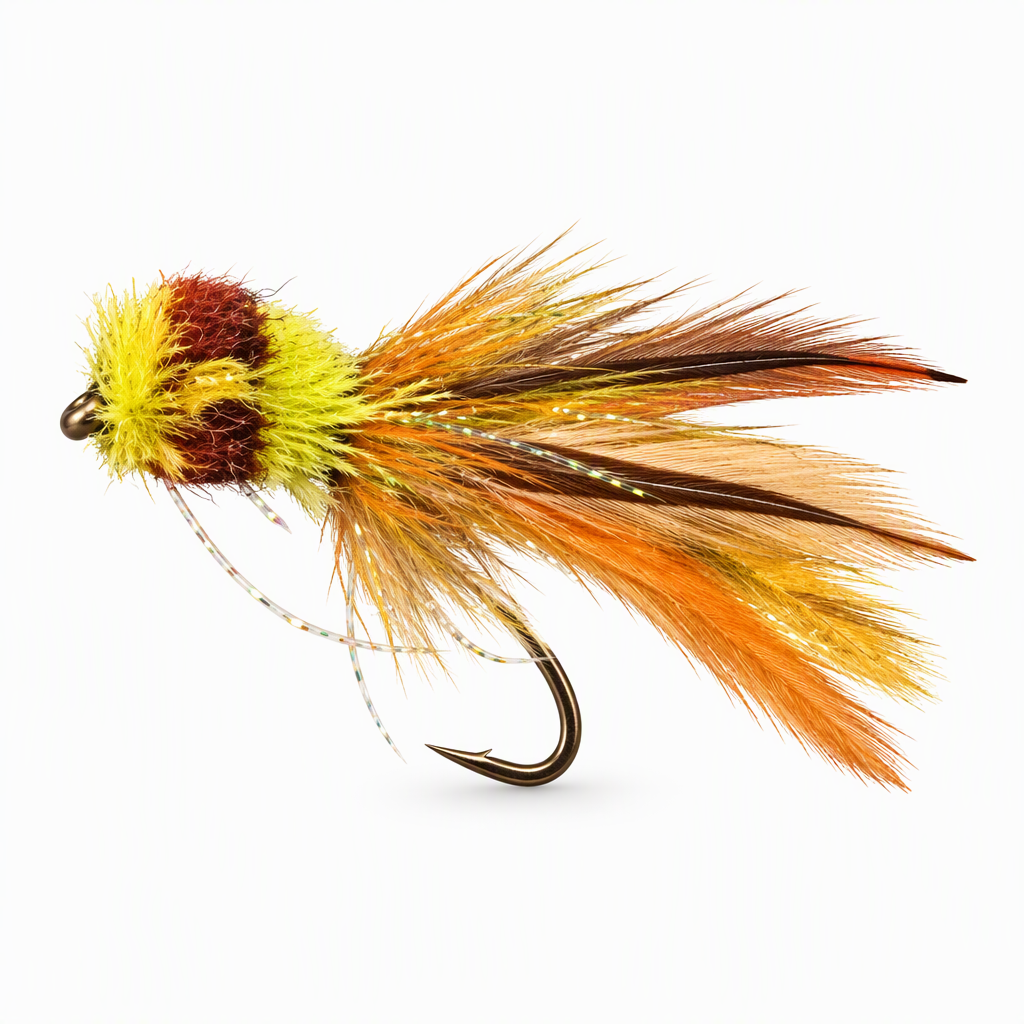
Whitlock Hair Bug
Dave Whitlock's deer-hair bass bug, also called the Whit Hair Bug, is a classic surface bug made from bands of spun and trimmed deer hair, trailed by rubber legs, marabou and flared hackle tails, with rubber leg-wings sticking out of the body. Whitlock described this refined 'Most Whithair' version in Fly Fisherman in 1976; its flat-shaved belly and sculpted face let it gurgle and pop when twitched over largemouth and smallmouth water. A monofilament loop guard lets it be fished tight to weeds and wood.
🪶 Ready to tie this?
This pattern needs 12 materials. Sign up free to check which ones you already own.
Materials
Mustad 94840 hook, sizes 1/0-8
1/0-8
Hard nylon monofilament snag guard, .018-.024 inch
Rubber skirt legs, two yellow and two black
Yellow, Black
Turkey marabou plume tip, black
Black
Soft, webby cock or hen hackles, two yellow and two black (solid or grizzly)
Yellow, Black
Two wide, soft cock hackles, black, fibres 1.5-2 times the hook gap
Black
Northern whitetail deer body hair, black and yellow (elk or antelope can substitute)
Black, Yellow
Large rubber hackle (leg-wings), black
Black · Large
Deer body hair, white (face)
White
Thinned Pliobond cement (or cellulose enamel) for the snag guard and thread wraps
Rod varnish for the face and belly
How to Tie the Whitlock Hair Bug
- 1
Step 1
Start the thread on the rear quarter of the shank and tie the monofilament snag guard on top of the shank just in front of the bend, flattening the end where it is tied down. Cement the wraps.
- 2
Step 2
At the bend, tie in two yellow and two black rubber legs, then a black marabou tip over them, all about one shank length long.
- 3
Step 3
Add the hackle tails: a yellow pair about three-quarters of a shank long, then a black pair roughly twice that length over them, set so they flare out to the left and right.
- 4
Step 4
Tie in the two black skirt hackles and wind them wet-fly style just ahead of the tails so the fibres sweep back over them.
- 5
Step 5
Spin and flare bunches of deer hair up the shank in colour bands (black, then yellow, then black), packing each bunch hard against the last. Between bands, tie in pairs of black rubber leg-wings so they stand out at right angles to the shank.
Dense, tightly packed hair floats higher and trims to a cleaner shape.
- 6
Step 6
Finish the body with a band of white deer hair for the face, leaving roughly the front fifth of the shank bare behind the eye, and secure the thread with a couple of half hitches.
- 7
Step 7
Take the bug out of the vise and shave the belly flat and close to the shank with a razor blade, then shape the top, sides and face with curved scissors.
- 8
Step 8
Bend the snag guard down under the hook, pass it through the eye so its loop hangs about half a hook gap below the point, and tie it down on the bare shank behind the eye. Whip finish.
- 9
Step 9
Coat the face and belly with rod varnish and let it dry, then trim any stray hairs.
Watch Tying Tutorial
https://www.youtube.com/watch?v=Bp487kuQxwY
Credit: The Anglers Art